ADVERTISEMENT

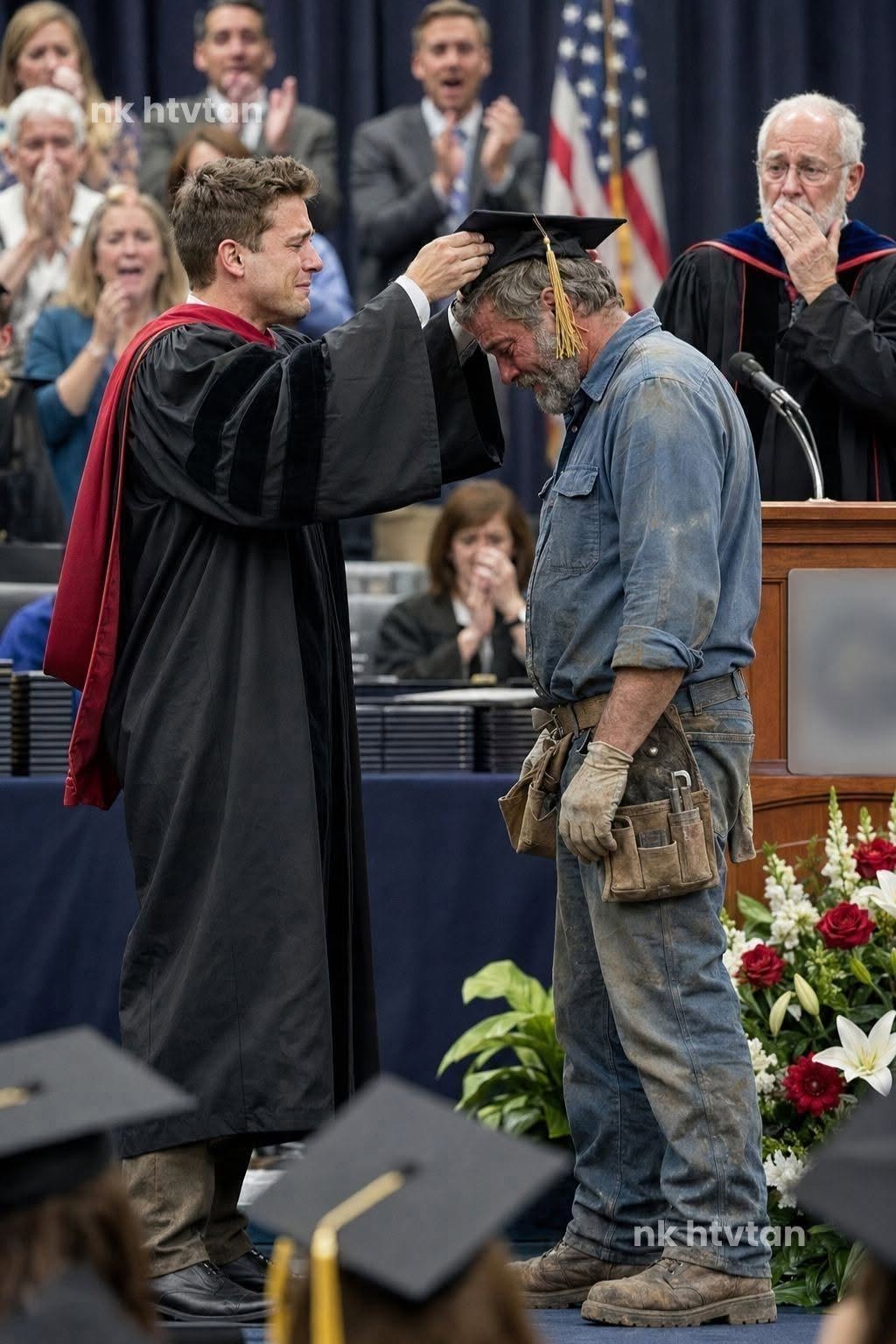
For twenty-five years, my stepfather broke his back on construction sites so I could become the first person in our family with a PhD. But on the day of my graduation, when my professor looked at him and whispered his name, the entire room went silent—because the man I called Dad had been carrying a story none of us knew. I did not come from a complete family. My parents separated when I was so young that my memories of my biological father are mostly shapes, not details. A hand at a doorway. A voice I cannot fully remember. A face that grew blurrier every year until, eventually, he became less like a father and more like a shadow people avoided mentioning. My mother, Rosa, took me to a small town outside Lafayette, Louisiana, where the roads ran beside rice fields and the wind always seemed to carry dust, rain, or both. We had very little. Our house was small, the roof complained during storms, and my mother stretched every dollar until it looked thin enough to tear. When I was four, she remarried. The man who entered our lives was not polished, educated, or wealthy. He did not arrive with promises wrapped in pretty words. He came with a bent back, sun-darkened skin, hands hardened by cement, and work boots that always seemed to carry a little of the construction site home with him. His name was Samuel Brooks. At first, I did not know what to make of him. He left before sunrise and came home after dark. He smelled of sweat, dust, concrete, and metal. His shirts were faded. His shoulders were always tired. He was quiet in a way that made me unsure whether he liked me or simply tolerated me because he loved my mother. But little by little, I learned his language. He fixed my broken bicycle without making me ask twice. He stitched the strap on my school bag when it tore. He repaired my sandals with glue and wire because we could not afford another pair until payday. He never shouted when I made mistakes. He simply cleaned up the mess, showed me how to do better, and carried on. When some older boys at school started picking on me, Samuel rode his old bicycle to get me. He did not make a scene. He did not threaten anyone. He simply stood there, dusty work shirt still sticking to his back, and looked at those boys until they suddenly found somewhere else to be. On the ride home, I sat on the back of his bicycle with my arms around his waist. He said only one thing. “I won’t ask you to call me Dad,” he told me. “But I will always show up for you.” That was the day he became my father. Not by blood. By choice. My memories of Samuel are simple things. His dusty uniform hanging near the door. His rusty bicycle leaning against the fence. The sound of him washing cement from his hands in the outdoor sink. The way he lowered himself into a chair every evening like his whole body had spent the day being argued with. No matter how tired he was, he always asked the same question. “How was school?” He was not an educated man. He had left school young because life did not ask him what he wanted. But he believed in education with a kind of reverence that made books feel almost sacred in our house. “Knowledge makes people listen,” he would tell me. “Study hard. If you have a mind, don’t waste it.” We had almost nothing, but he guarded my schooling like it was treasure. When I passed the entrance exam for Northlake State University, my mother cried so hard she had to sit down. Samuel did not cry. He went outside, lit a cigarette, and stood by the fence for a long time. The next week, his motorcycle was gone. I noticed immediately. “Where’s your bike?” I asked. He shrugged like it was nothing. “Sold it.” “For what?” He looked at me as if the answer should have been obvious. “For school.” My grandmother added her savings. My mother took extra sewing work. Samuel picked up more construction shifts until his hands cracked open and bled in winter. Somehow, they sent me to the city with a suitcase, two pairs of decent shoes, and more love than money. Samuel came with me to the dorm that first day. He arrived sweating through his shirt, wearing an old cap, carrying gifts from home in two heavy bags—rice, dried fish, peanuts, and jars of my mother’s pickled vegetables. Other students arrived with new laptops, storage bins, and parents who knew exactly where to park. I arrived with a stepfather who had calluses deep enough to look permanent. Before he left, he stood awkwardly near the dorm entrance. “Do your best,” he said. “Study hard.” I nodded, trying not to cry. Later, when I opened my lunch, I found a folded note tucked beneath the food. I may not understand what you study, but I will work for it. Don’t worry. I kept that note for years. College was not easy. Graduate school was harder. There were nights I wanted to quit. There were mornings I woke up exhausted, certain I was not as smart as everyone else. There were professors whose words made me feel small, classmates who wore confidence like expensive clothing, and bills that arrived with the patience of enemies. Every time I called home and said I was tired, Samuel gave the same answer. “Rest tonight. Continue tomorrow.” When I said the program was too difficult, he said, “Then difficult things are lucky to meet you.” When I worried about money, he said, “That is my worry. Your worry is studying.” Year after year, his back bent more. His hands grew rougher. His hair grayed at the temples. I told him more than once to stop working so much. He always waved me off. “I’m raising a doctor of philosophy,” he said proudly, though he pronounced it slowly, like each word was something delicate. “That is enough pride for one man.” By the time my dissertation defense arrived, Samuel had been working construction for twenty-five years. He insisted on coming. He borrowed a suit from a neighbor. The sleeves were slightly too short, and the shoes pinched his feet, but he polished them until they shone. My mother bought him a new hat because she said a father should look proper when his child becomes a scholar. He sat at the back of the room, back straight, hands folded over his knees, eyes fixed on me like I was standing on a stage bigger than any university could build. I defended my work. I answered questions. I spoke about research, theory, archives, methodology, and all the words that had once sounded impossible to me. When it was over, the committee stood. My professor, Dr. Harrison Cole, shook my hand first. “Congratulations,” he said. “You earned every letter after your name.” My mother covered her mouth and cried. Samuel sat frozen, as if clapping too loudly might disturb the moment. Then Dr. Cole turned toward the back of the room to greet my family. He smiled politely at my mother. Then his eyes landed on Samuel. The smile disappeared. For a second, my professor looked as if he had seen a ghost. The room went quiet. Samuel stood slowly, confused, one hand touching the brim of his new hat. Dr. Cole stepped closer. His voice changed. “You’re Samuel Brooks, aren’t you?” Samuel blinked. “Yes, sir.” I looked from one man to the other, unable to understand why my professor knew my stepfather’s name. Before Samuel could ask how they knew each other, Dr. Cole’s eyes filled with tears. And then he said the sentence that made everyone in that room stop breathing. “I have been looking for you for twenty-three years.” To be continued in Comment FULL STORY BELOW. 👇 👉 “Link in first comment 👇” IF THE LINK DOESN’T APPEAR, CLICK ON THE “MOST RELEVANT” OPTION AND SELECT “ALL COMMENTS”

ADVERTISEMENT

NY-For twenty-five years, my stepfather broke his back on construction sites so I could become the first person in our family with a PhD. But on the day of my graduation, …

NOTE: Hector Alvarez = Samuel Brooks; Elena = Rosa; Santiago Vale = rural town outside Lafayette, Louisiana; Metro City University = Northlake State University; professor = Dr. Harrison continue reading …

ADVERTISEMENT

Leave a Comment

ADVERTISEMENT